


China P2P stablecoin wallets grew 43x despite crypto restrictions: Chainalysis
The number of unique wallets sending peer-to-peer (P2P) stablecoin transactions in China grew 43-fold between the first quarter of 2024 and the second quarter of 2026, according to Chainalysis.
The blockchain analytics company recorded $104.1 billion across 18.1 million transfers involving China’s self-custodied stablecoin holdings during the 2026 reporting period, which ran from July 2025 to June 2026.
Stablecoin holdings turned over 33.2 times per year, more than three times the global average of 9.3, a pattern Chainalysis said was consistent with users treating stablecoins as working capital.
Chainalysis’s new report estimated that China’s crypto economy is worth at least $176 billion. Domestic P2P activity accounted for 59.1% of the total, 3.5 times its share in the 2025 reporting period.
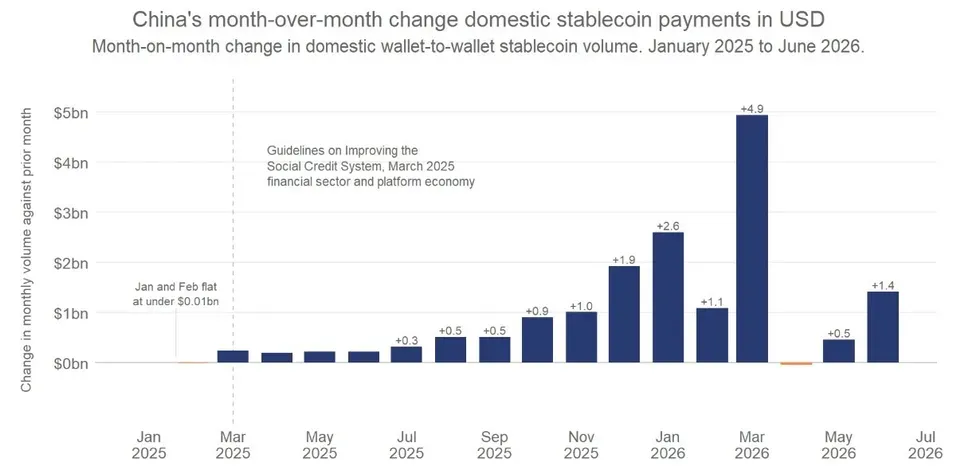
China’s domestic stablecoin transfer volume added $4.9 billion in March 2026, the largest monthly increase shown. Source: Chainalysis
KOREA
South Korea is East Asia’s largest crypto-economy despite 78% fall in exchange profits
Chainalysis ranked South Korea as East Asia’s largest crypto economy at $449.1 billion. Activity grew 12.3% in the year to June 2026, from the previous year, with retail traders showing a strong preference for AI-linked tokens.
However, the first half of 2026 has not been kind to South Korean crypto exchanges, which saw operating profits fall 78% as trading activity, market valuations and customer deposits declined.
The Korea Financial Intelligence Unit (KoFIU) said average daily trading volume at domestic virtual asset exchanges fell 44% from the previous six months, while market capitalization dropped 33% and won-denominated deposits fell 35%. Exchange sales declined 41% over the same period, even as the number of accounts eligible to trade rose slightly by 0.4%.
Securitize stock jumps 8% amid South Korea tokenization push
Shares of tokenization platform Securitize rallied sharply on Tuesday after the company announced a partnership with South Korean technology company LG CNS.
Securitize and LG CNS signed a memorandum of understanding to develop tokenized assets and digital asset infrastructure for South Korean financial institutions.
The partnership gives Securitize an early foothold in South Korea as the country prepares to implement a new framework for tokenized securities. Last week, the country’s Financial Services Commission proposed rules governing the issuance and circulation of tokenized stocks, bonds, funds and other securities, with the framework set to take effect in February 2027.
SINGAPORE
Standard Chartered plans institutional crypto custody in Singapore
London headquartered multinational bank Standard Chartered has announced plans to launch digital asset custody services for institutional clients in Singapore.
The firm will custody select cryptocurrencies, stablecoins and tokenized real-world assets for institutional clients and corporate clients qualifying as accredited investors.
Standard Chartered said Singapore’s role as a “leading financial and innovation hub” is an important part of its “global strategy.”
Independent Reserve adds cross border payments, subsidiary offers derivatives trading
Singapore-licensed crypto exchange Independent Reserve has added cross border payment tools enabling businesses to make fiat and stablecoin payouts. Accounts can be funded in Singapore or US dollars to make payments to suppliers or employees in more than 20 currencies. USDC and USDT are also options.
The exchange has also just launched crypto derivatives trading for sophisticated investors via subsidiary ReserveX.
Payward partners with Singapore Gulf Bank for crypto settlement
Payward, the parent company of Kraken, and Singapore Gulf Bank have announced a partnership to enable round-the-clock institutional crypto settlement.
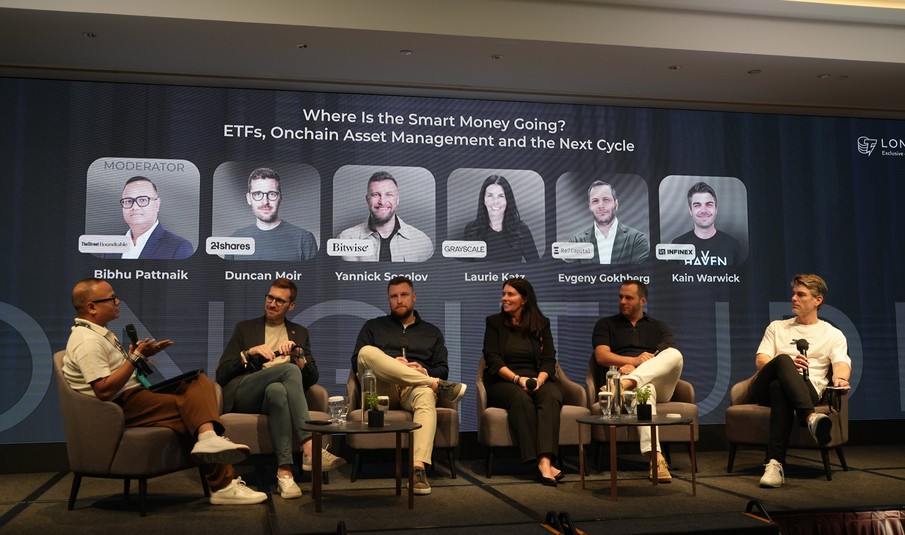
Cointlegraph’s Longtitude event in Singapore this week. Source: Cointelegraph
HONG KONG
Hong Kong officials double down on end-2026 deadline for crypto licensing bill
The Hong Kong government reaffirmed its plans to submit an amendment bill before the end of 2026 to establish licensing regimes for digital asset trading, custody, advisory and management services as part of its broader crypto licensing bill.
Secretary for Financial Services and the Treasury of Hong Kong, Christopher Hui, told a Monday policy briefing that the government will submit an amendment bill “within this year” to establish a broader framework for digital asset activities, according to a statement released by the Hong Kong government.
Hong Kong tops East Asia region for institutional activity
Hong Kong stood out in Chainalysis’s Geography of Cryptocurrency report for institutional activity. The data firm said institutional platforms accounted for 16% of service inflows, nearly three times the share in any regional neighbor. The city received almost $24 billion in inbound business-to-business flows. Hong Kong issued its first stablecoin licenses in April.
JAPAN
Japanese DEX use rises 200% since 2022
The Chainalysis report showed that in Japan, decentralized exchanges (DEXs) account for nearly 35% of service activity, the highest share among mature East Asian markets. Chainalysis said 65.7% of DEX swaps were between $10 and $1,000, and DEX activity had risen more than 200% since 2022.
Japanese lawmakers passed revisions in July that bring digital assets under the country’s financial-markets framework.
Japan adds Garantex to list of Russia sanctions over Ukraine war
The Japanese government has added Russian cryptocurrency exchange Garantex to its expanded list of sanctions against Russia, citing the continuing war in Ukraine.
Officials added 33 organizations and nine individuals linked to Russia to its asset-freeze list that restricts payments and capital transactions with the targeted parties, according to a joint statement issued on Friday by Japan’s Ministry of Foreign Affairs, Ministry of Finance and Ministry of Economy, Trade and Industry.
Garantex was previously sanctioned by the US, the EU and other jurisdictions for helping Russian entities evade financial restrictions.
INDIA
India-based scam targets US seniors via Bitcoin ATMs
India’s Central Bureau of Investigation (CBI) has arrested four people in an alleged international tech-support fraud and extortion racket targeting US nationals. The scam used fake computer pop ups displaying toll free “Microsoft” numbers. Victims who called were told their computers had been compromised, or connected to illegal activity like child porn, as part of a scheme to extort money from them. One Florida resident lost $440,000 to the scammers.
THAILAND
Meatspace attack forces victim to transfer $820K in crypto
Three armed assailants robbed a home in Bang Lamung, forcing a foreign resident to transfer crypto worth $820,000. They also took cash and three Rolex watches. Police suspect the robbers may be Chinese nationals.
Cointelegraph publishes long-form journalism, analysis and narrative reporting produced by Cointelegraph’s in-house editorial team with subject-matter expertise. All articles are edited and reviewed by Cointelegraph editors in line with our editorial standards. Some articles contain affiliate links, from which Cointelegraph may earn a commission. These relationships do not influence which products we review or our editorial conclusions. Content published in here does not constitute financial, legal or investment advice. Readers should conduct their own research and consult qualified professionals where appropriate. Cointelegraph maintains full editorial independence.