

Even before this year’s Spotify Wrapped dropped, I had a hunch what mine would reveal.
Lo and behold, one of my most-listened-to songs was an obscure 2004 track titled “Rusty Chevrolet” by the Irish band Shanneyganock. I heard it first thanks to my son, whose friend had been singing it on the swings at school. My son found it utterly hilarious, and it’s been playing in our house nonstop ever since.
Like parents all over the world, I rue how my son’s musical tastes have hijacked my listening history. But I’m also tickled to learn that our household is probably one of the few even listening to it.
Spotify Wrapped is an annual campaign by the popular streaming music platform. Since 2015, the streaming service has been repackaging user data – specifically, the listening history of Spotify’s users over the past year – into attractive, personalized slideshows featuring, among other data points, your top five songs, your total listening time and even your “listening personality.” (Are you a “Replayer,” a “Maverick” or a “Vampire”?)
As a consumer behavior researcher, I’ve thought about why these lists get so much attention each year. I suspect that the success of Spotify Wrapped may have a lot to do with how the flashy, shareable graphics are connected to a couple of fundamental – and somewhat contradictory – human needs.
Individuality and belonging
In 1991, social psychologist Marilynn Brewer introduced what she coined “optimal distinctiveness theory.”
She argued that most people are torn between two human needs. On the one hand, there’s the need for “validation and similarity to others.” On the other hand, people want to express their “uniqueness and individuation.” Thus, most of us are constantly striving for a balance between feeling connected to others while also maintaining a sense of our own distinct individuality.
At Thanksgiving, for example, your need for connection is likely more than satisfied. In that moment, you’re surrounded by family and friends who share a lot in common with you. In fact, it can feel so fulfilled that you may start craving the opposite: a way to assert your individuality. Maybe you choose to wear something that really reflects your personality, or you tell stories about interesting experiences you’ve had in the past year.
In contrast, you may feel relatively isolated when you move to a new town and feel a stronger need for connection. You may wear the styles and brands you see your neighbors and co-workers wearing, pop into popular cafes and restaurants, or invite people over to your home in an effort to make new friends.
Have it your way
When people buy things, they often make choices as a way to satisfy their needs for connection and individuality.
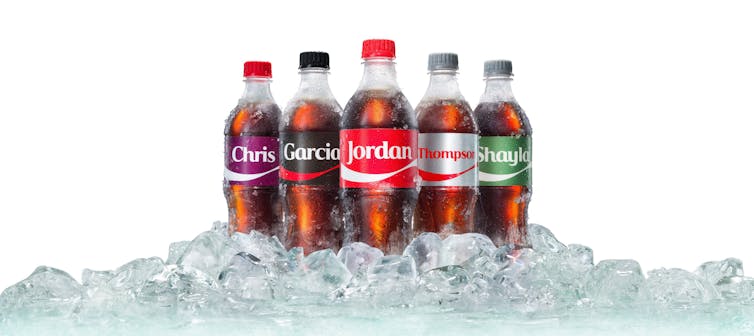
Brands recognize this and usually try to entice consumers with at least one of these two elements. It’s partly why Coca-Cola started releasing bottles featuring popular names on the labels as part of its “Share a Coke” campaign. The soft drink remains the same, but grabbing a Coke with your name on it can cultivate a sense of connection with everyone else who has it. And it’s why Apple offers custom, personalized engravings for products such as its AirPods and iPads.
Spotify Wrapped works because it nails the balance between competing needs: the desire to belong and the desire to stand out. Seeing the overlap between your lists and those of your friends fosters a sense of connection, and seeing the differences is a signal of your (or your kids’!) unique musical taste. It gives me a way to say, “Sure, I’ve been listening to ‘Soda Pop’ nonstop like everyone else. But I’m probably the only one playing ‘Rusty Chevrolet’ on repeat.” The Wrapped campaign is also smart marketing. Spotify turns listeners’ unique, personal listening data into striking visuals that are tailor-made for posting to social media accounts. It’s no wonder, then, that the Wrapped feature has led to impressive engagement: On TikTok, the hashtag #SpotifyWrapped garnered 73.7 billion views in 2023. The annual campaign has earned numerous honors, including a Cannes Lion and several Webby Awards, otherwise known as the “Oscars of the Internet.” It’s been so successful that it’s inspired a wave of copycats: Apple Music, Reddit, Uber and Duolingo now release similarly personalized “year-in-reviews.” None, however, has managed to achieve the same level of cultural impact as Spotify Wrapped. So what’s on your list? And will you brag, hide or laugh at what it says about you? Ishani Banerji, Clinical Assistant Professor of Marketing, Clemson University This article is republished from The Conversation under a Creative Commons license. Read the original article.