

Key takeaways
- Brand safety is the practice of protecting a brand’s reputation by controlling where and how it appears online, from ad placements to social media publishing.
- The most common brand safety risks in 2026 include AI-generated misinformation, ad adjacency to harmful content, bot amplification, and unvetted influencer partnerships.
- Internal brand safety policies give enterprise teams clear roles, approval workflows, content standards, and escalation plans so nothing gets published without the right checks.
- Tools like Hootsuite Social OS help enforce brand safety at scale through governed workflows, real-time listening, and AI-powered content review.
What is brand safety?
Brand safety is the set of practices that keep a brand’s ads, content, and conversations away from harmful, offensive, or misleading environments. It applies to paid media, where an ad might appear next to violent or extremist content, and to organic social, where a poorly reviewed post or an unmoderated comment thread can create the same reputational damage.
Most enterprise teams anchor their approach to industry standards. The Global Alliance for Responsible Media (GARM), a voluntary cross-industry initiative created in 2019 that the World Federation of Advertisers discontinued on August 9, 2024, produced the Brand Safety Floor, which defined the content categories advertisers universally avoid, such as hate speech, explicit content, and terrorism.
Although the initiative itself no longer operates, its Brand Safety Floor and Adjacency Standards Framework remain widely used as legacy industry reference points. The IAB and accredited verification vendors then measure whether placements actually stayed inside those lines.
The practical point for marketers: Brand safety is not a single tool or a one-time audit. It is a system of standards, workflows, and monitoring that has to work across every team touching your brand. For a broader look at the fundamentals, see our guide to protecting your brand across social channels.
Brand safety vs. brand suitability
Brand safety is about avoiding content that no advertiser wants to be near, while brand suitability is about deciding what’s appropriate for your specific brand, audience, and moment. Safety is the universal floor. Suitability is where your own values, category, and risk tolerance come in.
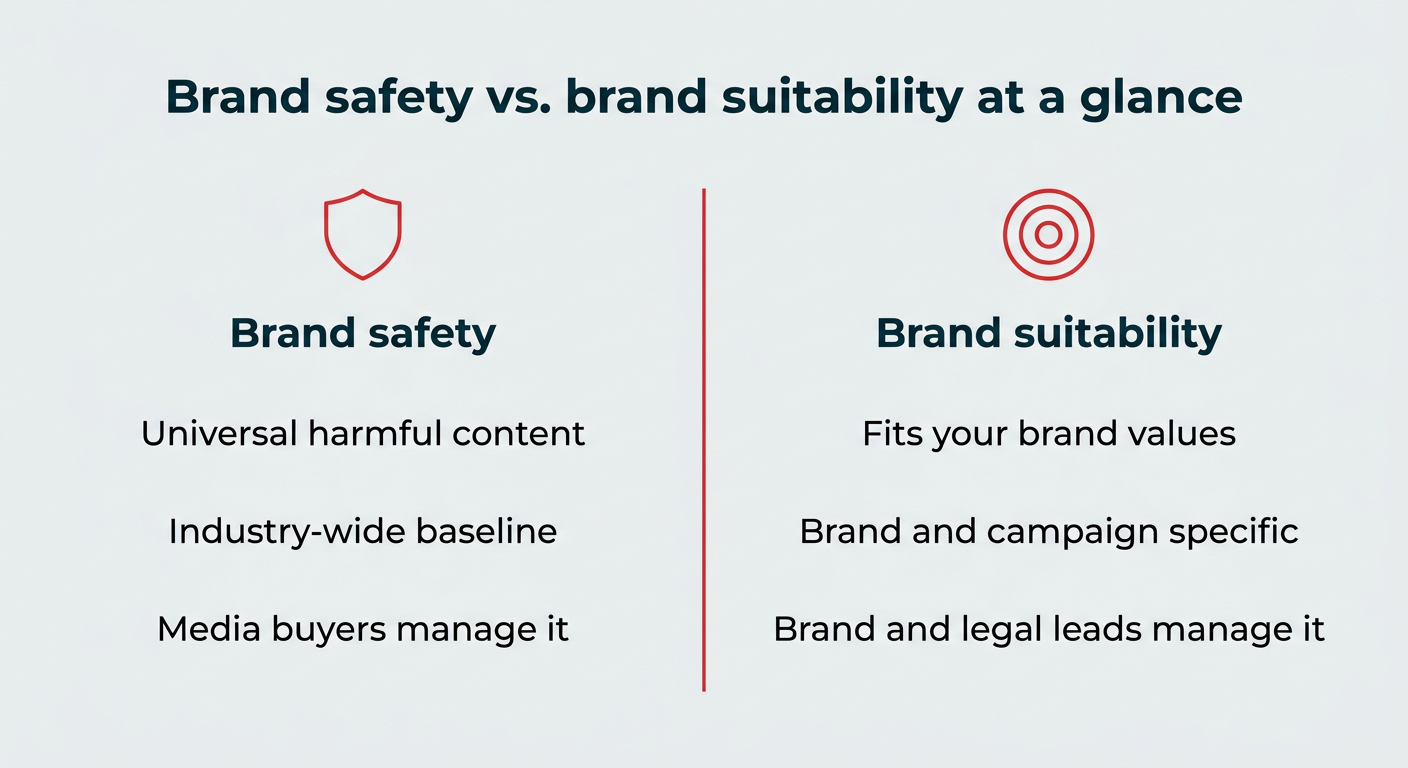
A news article about a natural disaster clears the brand safety floor. It may still be unsuitable for a travel brand running a beach campaign. Both decisions matter, but they’re made by different people using different criteria.
|
Brand safety |
Brand suitability |
|
|---|---|---|
|
Definition |
Avoiding universally harmful or illegal content |
Choosing content contexts that fit your brand values and audience |
|
Scope |
Industry-wide baseline (legacy GARM Brand Safety Floor) |
Brand-specific, campaign-specific, and often market-specific |
|
Who manages it |
Media buyers, verification vendors, platform policy teams |
Brand, marketing, and regional leads with legal input |
|
Example |
Blocking ads from appearing alongside violent or extremist content |
A family brand opting out of adjacency to political debate content |
In short: Safety keeps you out of trouble, suitability keeps you on-brand.
What are the most common brand safety risks in 2026?
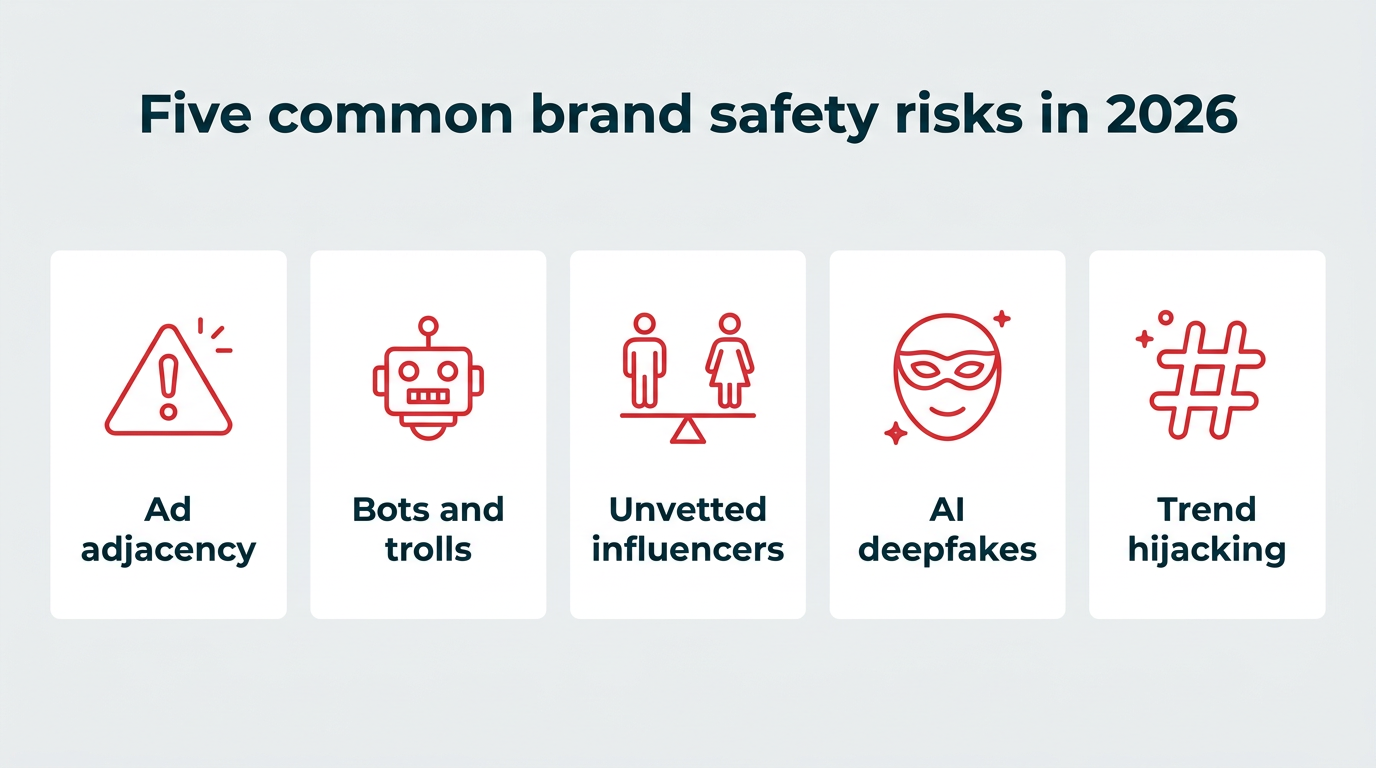
The risk landscape has shifted as AI-generated content, automated amplification, and creator-led media have all scaled at once. Most incidents enterprise teams face today fall into one of five categories.
- Ad placement next to harmful or inappropriate content
- Bots, trolls, and coordinated inauthentic behavior
- Unvetted influencer partnerships
- Misinformation and AI-generated deepfakes
- Hashtag and trend hijacking
Ad placement next to harmful or inappropriate content
Programmatic buying accounts for over 90% of US digital display ad spending, which means adjacency decisions happen faster than any human can review them. A single misconfigured campaign can put your logo next to content that contradicts everything your brand stands for.
Inclusion lists (approved placements only) give tighter control than exclusion lists, which chase problems after they appear. Most enterprise teams run both, paired with keyword and category blocks, and audit placement reports monthly rather than at campaign wrap.
Bots, trolls, and coordinated inauthentic behavior
Automated accounts can flood a comment section, distort sentiment data, and make a minor complaint look like a mass backlash. Coordinated groups do the same thing deliberately, often targeting brands during product launches or public announcements.
The danger is not just the noise. It’s that teams overreact to manufactured outrage or miss a genuine issue buried underneath it. Reliable listening data and a clear threshold for what counts as a real incident help teams tell the difference.
Unvetted influencer partnerships
When a creator’s past content or ongoing behavior surfaces mid-campaign, the association lands on your brand. Vetting has to cover more than follower counts: past posts, audience authenticity, brand conflicts, and how the creator handles criticism.
Contracts should also spell out content approval rights, disclosure requirements, and exit terms so you can end a partnership quickly without a legal fight.
Misinformation and AI-generated deepfakes
Synthetic media is now cheap enough that fake endorsements, fabricated executive statements, and cloned brand accounts are a routine problem. Gartner found 62% of organizations experienced a deepfake incident in the prior 12 months. These assets spread faster than corrections and are difficult to verify at scale.
Practical defenses include monitoring for brand and executive name mentions across video and audio, registering trademarks for takedown requests, and pre-drafting response templates so legal and comms are not writing from scratch during an incident.
Hashtag and trend hijacking
Jumping on a trend without checking its origin is one of the easiest ways to attach your brand to a movement, meme, or campaign you never intended to support. Trends also change meaning quickly, sometimes within hours.
A short pre-publish check works well here: who started the trend, what else is using the hashtag right now, and would we be comfortable if a screenshot of our post ran in a news story.
What are internal policies for brand safety?
Those risks are what internal policies exist to contain. Internal policies for brand safety are the rules, workflows, and guardrails that guide how teams show up on social media.
These policies help people know what’s safe to post, how to review content, and how to follow brand safety measures when something goes wrong.
Large organizations need them because the bigger the organization, the harder it is to keep every post aligned with brand values and safety standards. With many teams, regions, and partners involved, the risk of harmful content, misinformation, or accidental missteps increases fast, especially as algorithms and bots amplify issues.
Here’s how internal brand safety policies help large teams:
- Reduce brand safety concerns by outlining what counts as unsafe content (like hate speech, offensive content, or misleading claims).
- Keep workflows consistent so posts move through the right checks before going live.
- Protect the brand’s reputation when handling real-time issues or crisis moments.
- Support legal and compliance needs, especially for regulated industries.
- Train new team members so everyone understands brand values, brand suitability, and safety expectations from day one.
Below is a simple table that breaks down the difference between the three — since they’re often confused but serve very different roles.
|
Type |
What it covers |
Who it’s for |
Why it matters |
|---|---|---|---|
|
Internal brand safety policies |
Workflows, approvals, permissions, escalation rules, what’s allowed/not allowed, how to handle unsafe content |
Internal teams, agencies, franchisees, partners |
Keeps publishing safe, consistent, and compliant across the entire organization |
|
Social media guidelines |
Tone of voice, visual style, posting etiquette, community rules |
Anyone creating content for the brand |
Helps teams stay on-brand and maintain a consistent identity |
|
External brand safety practices |
Ad placement, adjacency rules, avoiding unsafe environments, ad fraud prevention, accreditation with IAB/IAS/DoubleVerify |
Media buyers, advertising teams, programmatic partners |
Ensures ads don’t appear next to harmful or inappropriate content |
Most enterprise teams need all three working together. Internal policies are where the other two get operationalized day to day.
What are the key components of an effective internal brand safety policy?
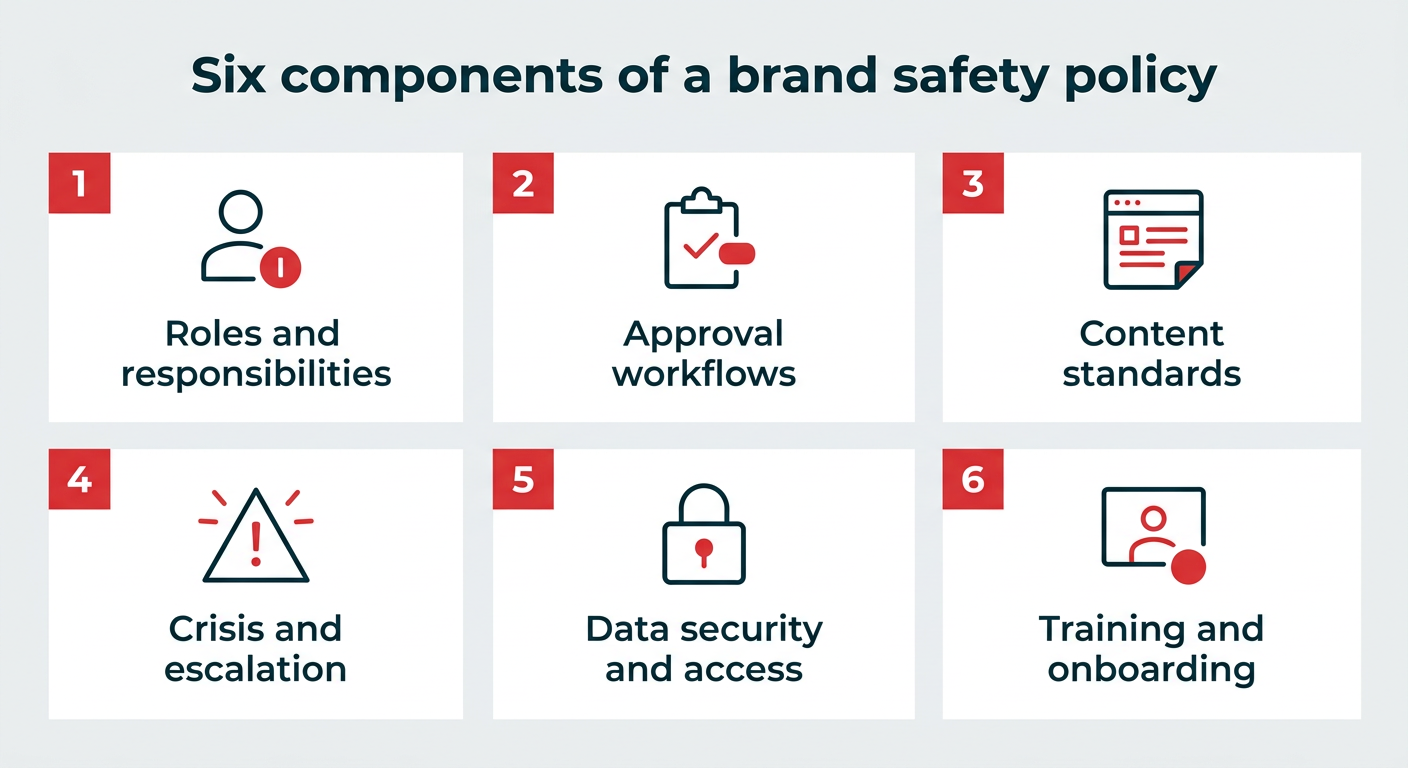
A strong brand safety policy gives teams a clear roadmap. It explains how content should be created, reviewed, approved, monitored, and handled if things go wrong.
Here are the core elements every enterprise needs.
1. Roles and responsibilities: define who owns what
A safe brand starts with clear ownership. People need to know exactly what their job and what parts of the social strategy they own, so that nothing gets missed and content stays within approved content categories.
Most enterprise teams define roles like this:
- Creators who write posts and collect assets
- Editors who check accuracy, tone, and brand values
- Compliance or legal reviewers who handle anything that needs extra care
- Approvers who give the final “yes”
- Channel owners who watch comments and conversations
- Escalation leads who step in during urgent or risky situations
When everyone knows their role, teams move faster and make fewer mistakes.
2. Approval workflows, permissions and publishing guardrails
Approval workflows keep your brand safe by making sure every post is reviewed before it goes live. Permissions and guardrails control who can draft, edit, or publish content, so only trained team members make final decisions.
A strong setup should include:
- A clear Draft → Review → Approve → Publish path
- Permissions that limit who can edit, approve, or publish
- Rules for high-risk content, like claims, user-generated content, or influencer posts
- A simple way to flag risky content for human review
- An escalation plan when something needs legal or PR support
Hootsuite Social OS makes this easier: Perch handles publishing and approval routing, while Vigil applies the governance layer so every post moves through the right steps.

3. Content standards (AKA what is and isn’t okay to publish)
Content standards help every team understand what counts as brand-safe content. They set clear rules for tone, visuals, claims, and sensitive topics so people don’t have to guess what’s allowed.
Strong content standards should include:
- Tone and voice guidelines that match your brand values
- Rules for high-risk content like claims, partnerships, or health advice
- Clear examples of unsafe content, such as hate speech, misinformation, or offensive content
- Guidelines for user-generated content, influencer posts, and employee advocacy
- Requirements for image, video, and format quality
- A list of topics, keywords, or content categories that need extra review
4. Crisis detection and escalation plans
Even with great policies, things can still go wrong. That’s why every enterprise needs a clear plan for spotting issues early and knowing who to alert.
A strong escalation plan should outline:
- What counts as a risk (e.g., harmful content, misinformation, sudden spikes in mentions)
- Who reviews issues first
- Who needs to be notified in legal, PR, or leadership
- What steps to take in the first hour
- When to pause publishing across social media channels
- How to track the incident from start to finish
Lumen, the insights and listening app inside Hootsuite Social OS, plus real-time alerts and other monitoring tools, help teams catch problems early. Clear escalation paths then stop small issues from becoming bigger ones, or help bring customer sentiment back up after a fallout. See the Hong Kong Airlines example below for how that plays out in practice.
5. Data security, access controls, and account protection
Brand safety also means protecting your accounts from bots, bad actors, and simple mistakes. Lost passwords, expired access, or the wrong person posting at the wrong time can all create risk.
A strong policy should include:
- Role-based access so people only see what they need
- Regular audits of who has account access
- Two-factor authentication for every login
- Password rotation and high-quality secure storage
- Rules for removing access when employees change roles
- Platform-based protections like login alerts and session monitoring
Hootsuite makes this easier with role permissions, account ownership controls, and unified login, so teams stay safe without creating bottlenecks.

Source: Reddit
6. Training and onboarding for every role
Brand safety policies only work when people understand them. Training helps new and existing teams learn how to follow workflows, use tools, and avoid risky content.
Training should cover:
- How to spot unsafe content and understand brand suitability
- How to use approval workflows and permissions
- What to do in a crisis
- How to manage influencer and UGC content
- Brand voice, tone, and safety rules
- Platform-specific risks (e.g., trending challenges, viral misinformation)
Many enterprises run quarterly refreshers, short certifications, or on-demand video training to keep this info fresh and relevant. However you present it, make it part of your regular training programs.
How to implement internal policies for brand safety effectively
A brand safety policy only works if people can actually follow it. Implementation is about turning rules into daily habits, supported by clear workflows, training, and the right tools.
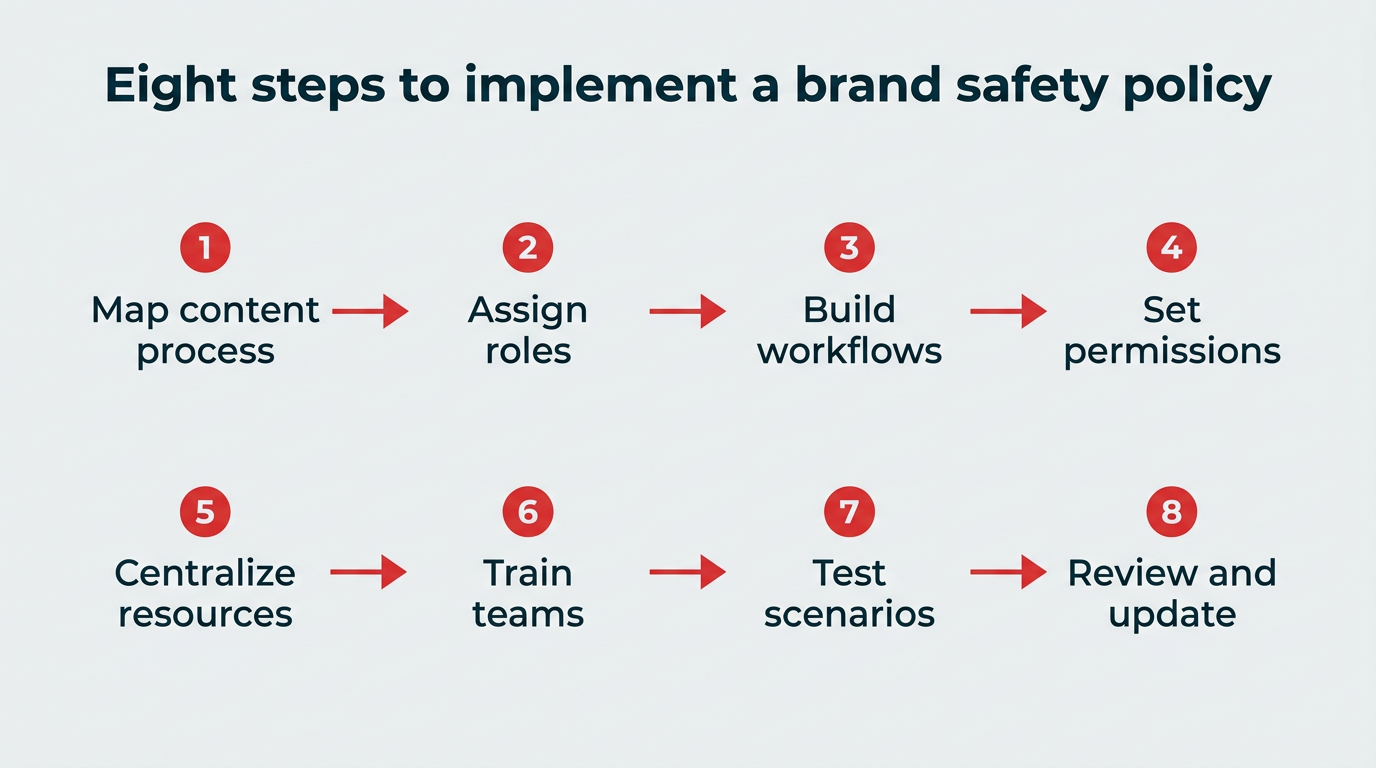
Here’s the short version of the eight steps:
- Map how content gets made today
- Assign clear roles so everyone knows what they own
- Build approval workflows and publishing guardrails
- Set permissions so only the right people can publish
- Put all brand safety resources in one place
- Train everyone who touches social media
- Test the policy with real scenarios
- Review and update it on a regular schedule
Here’s what each step looks like in detail.
1. Start by mapping how content gets made
Before fixing anything, look at how your process really works today.
Map out the following:
- Who drafts content
- Who edits
- Where assets live
- How approvals happen
- Who publishes
- Where problems get flagged
Most teams find hidden steps, bottlenecks, or “unofficial shortcuts” that create risk. Mapping it out ahead of time gives you a clear starting point.
2. Assign clear roles so everyone knows what they own
Brand safety falls apart when people assume someone else is checking the work. A simple roles list solves that.
Define:
- Who drafts and edits posts
- Who approves them
- Who can publish
- Who handles legal and compliance questions
- Who manages escalation when things go wrong
3. Build approval workflows and publishing guardrails
Once roles are set, turn them into a workflow the whole team follows.
A solid workflow includes:
- Required approvals for each type of content
- Extra checks for regulated topics
- A fast path for real-time posts
- One shared place to review, comment, and approve
- A final review before anything goes live
Within Hootsuite Social OS, you can set these rules once and apply them across all your social accounts. No DMs. No screenshots. No confusion.
4. Set permissions so only the right people can publish
Permissions are one of the strongest brand safety tools you have. They keep your social accounts protected and limit who can push content live.
Best practices include:
- Giving publish access to only a few trusted users
- Reviewing access every quarter
- Turning on two-factor authentication
- Removing access as soon as someone changes roles
Role-based permissions in Vigil, paired with Perch for publishing, make this easy for large teams with lots of moving parts.
5. Put all brand safety resources in one place
Your team shouldn’t have to hunt through old PDFs, random folders, or Slack threads to find the rules.
Create one central hub with:
- Brand tone and style guidelines
- High-risk topics and restricted content
- Examples of approved language
- Rules for influencers, user-generated content, and vetting workflows
- A simple escalation path and contact list
- Crisis do’s and don’ts
When everything lives in one place, people actually use it.
6. Train everyone who touches social media
Training is where your policy becomes muscle memory. It doesn’t need to be complicated — it just needs to be consistent.
Cover:
- What brand safety means for your organization
- How to use your workflows
- What unsafe content looks like (with real examples)
- How to flag issues quickly
- What to do during a crisis moment
Short, repeatable training sessions work great. Some teams even build them into onboarding so every new hire starts on the same page.
Enterprise teams can lean on Hootsuite onboarding, coaching, and select Academy courses to build the brand safety skills they need. Teams that want more can upgrade to Premier Services for full Academy access and custom training.

7. Test the policy with real scenarios
A policy might look strong on paper and still fall apart in practice. Testing shows you if it holds up.
Run drills for things like:
- A sudden wave of customer complaints
- A risky influencer post that hasn’t been vetted
- Misinformation or unsafe content spreading in the comments, especially without content moderation
- A publishing mistake
- A trend that might clash with brand values
These exercises help teams feel confident before a real issue hits.
8. Review and update it on a regular schedule
Social media changes constantly, so your policy should never sit still.
Review it:
- Every 6-12 months
- After a major platform update
- After a close call or crisis
- When your brand values or org structure shifts
If you need a social media policy template, we have you covered. This template will teach your teams how to set clear social media expectations for employees, how to handle customer inquiries and questionable content, and how to manage PR crises and ensure copyright compliance. Check out this blog on creating social media policies for further learning.
What best practices help maintain brand safety over time (according to the experts)?
To understand more about brand safety policies, we asked Nick Martin, Social Media Lead at Tilpati, how he sets guardrails without scaring employees away from posting.
1. Give people a clear, safe starting point
Martin says every brand safety strategy starts with removing uncertainty. When employees aren’t sure what’s allowed, they either freeze or take risks.
He recommends giving teams an easy, approved path so posting feels safe rather than intimidating. As he explains, tools that offer “a very clear and brand-approved way for employees to share” help people understand how to show up online without crossing lines.
One way to do that, he explains, is through a centralized advocacy tool. “I recommend using an employee advocacy tool (like Parliament) because it provides a very clear and brand-approved way for employees to share,” Martin shares.
Employees connect their accounts, choose from pre-approved posts, and avoid the risks that come with writing from scratch.

2. Treat brand safety like ongoing training, not a one-time document
Policies fade when they aren’t reinforced. Martin keeps them active by teaching teams how to apply them in real situations. “I recommend creating a presentation for new hires… and then be sure to have follow up sessions throughout the year to help keep your tips fresh,” Martin notes.
“That will inform them on how to effectively share about the company on social media. If you can record that presentation and have it be automated, even better!”
This ongoing education makes people confident instead of cautious. It helps them understand why certain rules and brand safety guidelines exist, and how to use good judgment when something unexpected comes up — which is where most brand safety issues happen.
3. Use positive guidance instead of fear-based rules
Brand safety policies fall apart when people feel unsure or afraid to participate. Martin stresses that guidelines should protect the brand without pushing employees away from social.
“Make sure you work with legal or HR to create clear social media guidelines,” Martin says. But, tone matters. Policies written like threats only discourage employees from posting at all, no matter the organization’s risk tolerance.
Martin recommends avoiding language like, “Do NOT speak against the organization. If you do this, you will be at risk of termination,” because it shuts people down.
Instead, he suggests simple expectations such as “be aware to not share customer or private data in a social post.” It’s direct, understandable, and still protects the brand.
He also believes strong reinforcement keeps the policy alive over time. “If you are seeing your employees sharing on social media and you see a post that’s well put together, take a screen grab and give that person a shoutout,” Martin says.
Highlighting great examples — and explaining why they work — gives everyone a clear model to follow and encourages the kind of behavior your policy is built to support.

Source: LinkedIn
How is AI changing brand safety in 2026?
AI is reshaping brand safety from both directions: it makes harmful content cheaper to produce and easier to detect. For enterprise teams, that means the threat volume is up, but so is the ability to spot problems before they scale.
On the risk side:
- Synthetic media: Deepfaked executive statements and fake brand endorsements are now inexpensive to produce and hard to verify quickly.
- Volume: AI-generated spam, review manipulation, and cloned accounts can flood a channel faster than manual moderation can keep up.
- Unreviewed AI content: Teams using generative tools without a review step risk publishing inaccurate claims or off-brand messaging at scale.
On the solution side:
- Real-time detection: AI-powered listening flags sentiment shifts, coordinated activity, and emerging narratives earlier than manual monitoring.
- Content review at scale: Automated checks can screen drafts against content standards before a human approver sees them.
- Governed workflows: The important part is keeping AI inside the same guardrails as human output. Approvals, audit trails, and permissions should apply to AI-assisted content exactly as they do to anything else.
The takeaway for marketing leaders: AI does not replace your brand safety policy. With Gartner projecting enterprise misinformation spending to surpass $30 billion by 2028, it raises the stakes for having one that covers machine-generated content as explicitly as it covers human-generated content.
Real-world brand safety examples
Brand safety is easiest to understand through what actually happens when it works and when it fails. Here are three patterns enterprise teams should recognize.
Ad adjacency failure
The classic brand safety failure is programmatic: a major advertiser’s pre-roll runs ahead of extremist or violent video content, someone screenshots it, and the brand spends the next week explaining a placement it never chose. The fix is rarely a single blocklist. It’s tighter inclusion lists, third-party verification, and reviewing placement reports while campaigns are still live rather than after they close.
Crisis turned into an opportunity
Hong Kong Airlines used Lumen by Hootsuite alerts to spot a mispriced fare going viral. Because the team saw it early, they were able to decide quickly to honour the fare rather than argue about it publicly, and the response turned a pricing error into a goodwill story — with the airline seeing a 4,900% increase in engagement.

Source: Hong Kong Airlines
Trend participation gone wrong
Brands regularly attach themselves to a trending hashtag without checking where it came from, then discover it originated with a tragedy, a protest, or a competitor’s campaign. The result is a deleted post and an apology. A two-minute origin check before publishing prevents nearly all of these, which is exactly the kind of step that belongs in a written policy rather than in someone’s head.
How does Hootsuite Social OS support brand safety at scale?
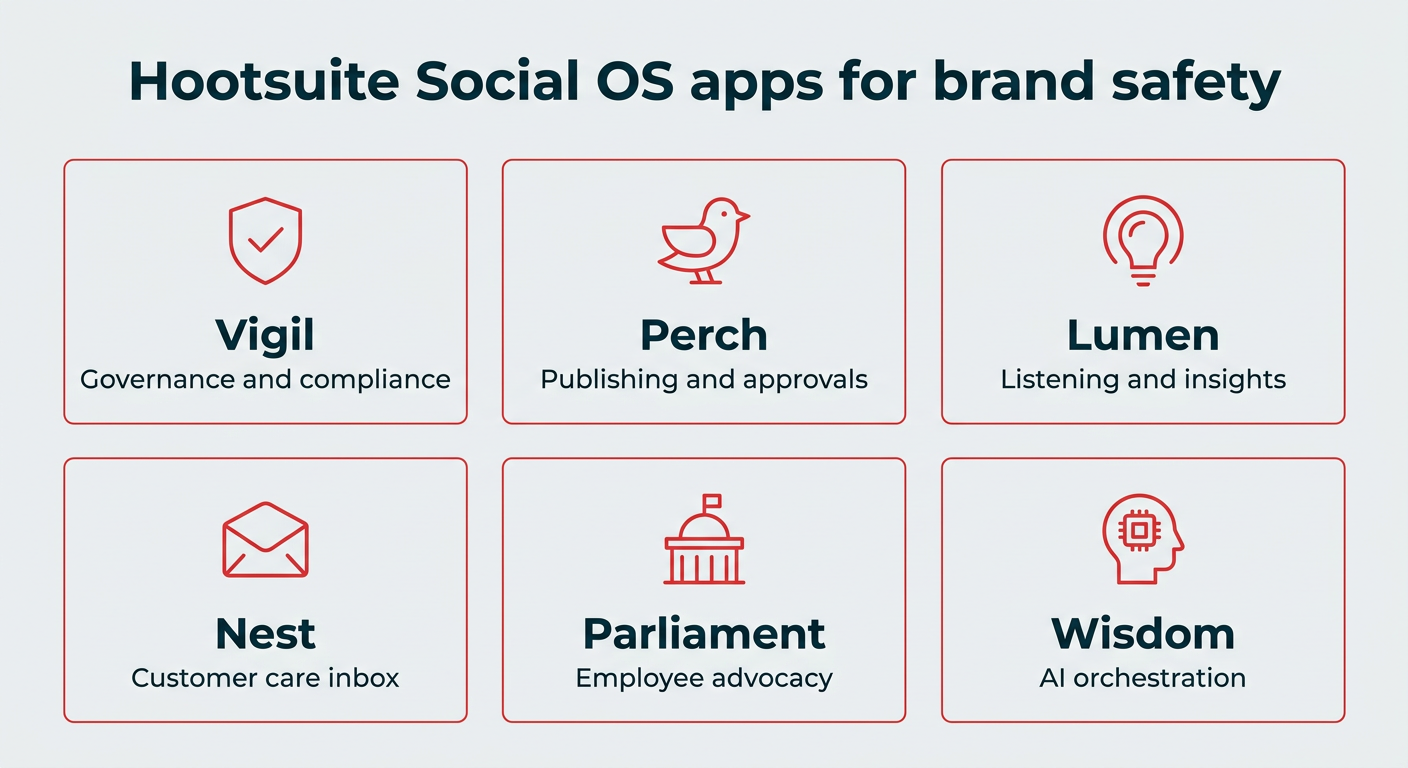
Hootsuite Social OS gives large teams one connected system to plan, review, approve, publish, and monitor safely. Here’s how Hootsuite for enterprise teams maps to brand safety work:
- Vigil: The compliance and governance layer, covering team permissions, approval enforcement, access controls, and audit trails that show who did what and when.
- Perch: Content planning, scheduling, and approval routing, plus a content library so teams publish from approved copy and assets instead of starting from scratch.
- Lumen: Real-time social listening and insights for crisis detection, sentiment monitoring, and spotting risky conversations before they grow.
- Nest: The customer care inbox, with moderation rules and sentiment-based prioritization so sensitive messages reach the right person quickly.
- Parliament: Employee advocacy built on pre-approved content, so staff can share without drafting risky posts themselves.
- Wisdom: AI orchestration inside governed workflows, with cited answers and enterprise-grade controls so AI-assisted content follows the same rules as everything else.
- Connectors and integrations: Connect to the security, compliance, and monitoring providers your organization already uses.
FAQ: Brand safety
What does brand safety mean?
Brand safety means ensuring a brand’s content and advertising appear only in environments that are appropriate and free from harmful, offensive, or misleading content. It covers both paid placements and organic social publishing.
Can you give me an example of brand safety?
A common brand safety example is when a company’s programmatic ad appears next to extremist or violent content on a video platform, damaging the brand’s reputation by association. Inclusion lists and third-party verification are the standard defenses.
What is the difference between brand safety and brand suitability?
The difference between brand safety and brand suitability is scope: brand safety focuses on avoiding universally harmful content like hate speech or violence, while brand suitability is about whether specific content aligns with a particular brand’s values and audience.
How does AI affect brand safety in 2026?
AI affects brand safety in 2026 by both creating new risks, such as deepfake content and AI-generated misinformation, and enabling new solutions like real-time content moderation and governed AI workflows. Policies should cover AI-assisted content as explicitly as human-created content.
What are internal policies for brand safety?
Internal policies for brand safety are the documented rules and steps teams follow to keep the brand protected on social media. They explain what’s safe to post, what to avoid, and how to handle risks so every team stays aligned.
Who should own brand safety policy implementation in an organization?
Brand safety policy implementation should be owned by a mix of teams. Social leads run the day-to-day, while legal or compliance sets the guardrails. Brand or comms teams often guide updates and make sure the policy matches the organisation’s goals.
How often should these policies be reviewed and updated?
Internal brand safety policies should be reviewed at least once a year. Many large organisations check in quarterly, especially when platforms, laws, or team structures change.
How can internal policies scale across regions and languages?
Internal policies scale across regions by starting with one main policy and adding short local versions for cultural norms and legal needs. Shared templates, content libraries, and role-based permissions help every market stay consistent while still sounding local.
What metrics show policy effectiveness?
Metrics that show policy effectiveness include approval cycle time, the number of publishing errors caught before going live, incident count per quarter, and time to first response during escalations. Strong policies also lead to more consistent content and fewer escalations overall.
Which tools help enforce internal brand safety policies?
Tools that help enforce internal brand safety policies include role-based permissions, approval workflows, content libraries, and monitoring tools. Hootsuite Social OS combines these controls through Vigil for governance, Perch for publishing approvals, and Lumen for listening, so teams can follow the rules without slowing down.
Save time managing your social media marketing strategy with Hootsuite. Publish and schedule posts, find relevant conversions, measure results, and more â all from one dashboard. Try it free today.