


Key takeaways
- A social media style guide removes day-to-day decisions so your team stays consistent across every platform, whether content comes from a person or an AI tool.
- The 10 core elements to include: Accounts and audience, voice and tone, visual style, language rules, hashtags, content policies, CTAs, AI guardrails, brand terminology, and dos and don’t’s.
- Your guide should flex by platform, with specific rules for how voice, format, and visuals adapt across Instagram, LinkedIn, TikTok, X, and others.
- Treat it as a living document. Start with a first version, then review quarterly and update when platforms, tools, or team structure change.
A social media style guide is a document that defines how your brand looks, sounds, and behaves across every social platform. It covers everything from your visual identity (e.g., your logo and color palette) to your tone of voice, and even how you use emojis and hashtags. Some teams call it social media brand guidelines, but the purpose is the same.
These days, a style guide covers more than what your core social team publishes. It also governs AI-generated drafts, content shared by employees, and work coming from agencies or regional teams.
The point of a style guide isn’t to add rules, it’s to remove decisions. It means your team isn’t second-guessing the tone or punctuation of every post. It gives them one source of truth for staying consistent across channels.
A strong style guide works alongside your social media strategy, translating high-level goals into the day-to-day rules your team actually follows.
Bonus: Get a free, customizable social media style guide template to easily ensure a consistent look, feel, voice, and tone across all your social channels.
Your brand needs a social media style guide to stay consistent across every platform, onboard new team members faster, and build long-term trust with your audience.
Here’s a closer look at each benefit:
Keeps your image and voice consistent
A social media style guide locks in the decisions that keep your brand recognizable online. Without clear guidelines, every team member ends up making their own micro-decisions, and your feed can start to feel inconsistent.
Style guides aren’t just for humans, either. They’re also what makes AI-generated content usable. AI tools are great for writing first drafts, but the outputs tend to sound generic. With a style guide, your editors know exactly what to fix: the words that don’t fit, the tone that’s off, or the emojis your brand doesn’t use.
Pro tip: You can also feed your style guide directly into AI tools for a faster turnaround.
Makes onboarding faster
A social media style guide gives new hires and freelancers a place to learn how your brand shows up on social, rather than piecing it together from past posts.
It also protects organizational knowledge. When team members change roles or move on, the decisions they made about voice, visuals, and more stay documented for whoever comes next. New people can then ramp up faster without any disruptions to your content.
Builds trust with your audience
Your followers should be able to recognize your content, no matter where they see it. When you define your voice, tone, and visual style in your style guide, social media content creation becomes easier. And, all your content sounds like it’s coming from the same source.
A good style guide also helps your team talk about your product or service in a consistent way. Marq and Demand Metric found that 68% of organizations say brand consistency contributed at least 10% to their revenue growth, so that repetition pays off when your audience is ready to buy.
Not sure what to put in each section? The walkthrough below covers all 10 elements, in the same order the template does.
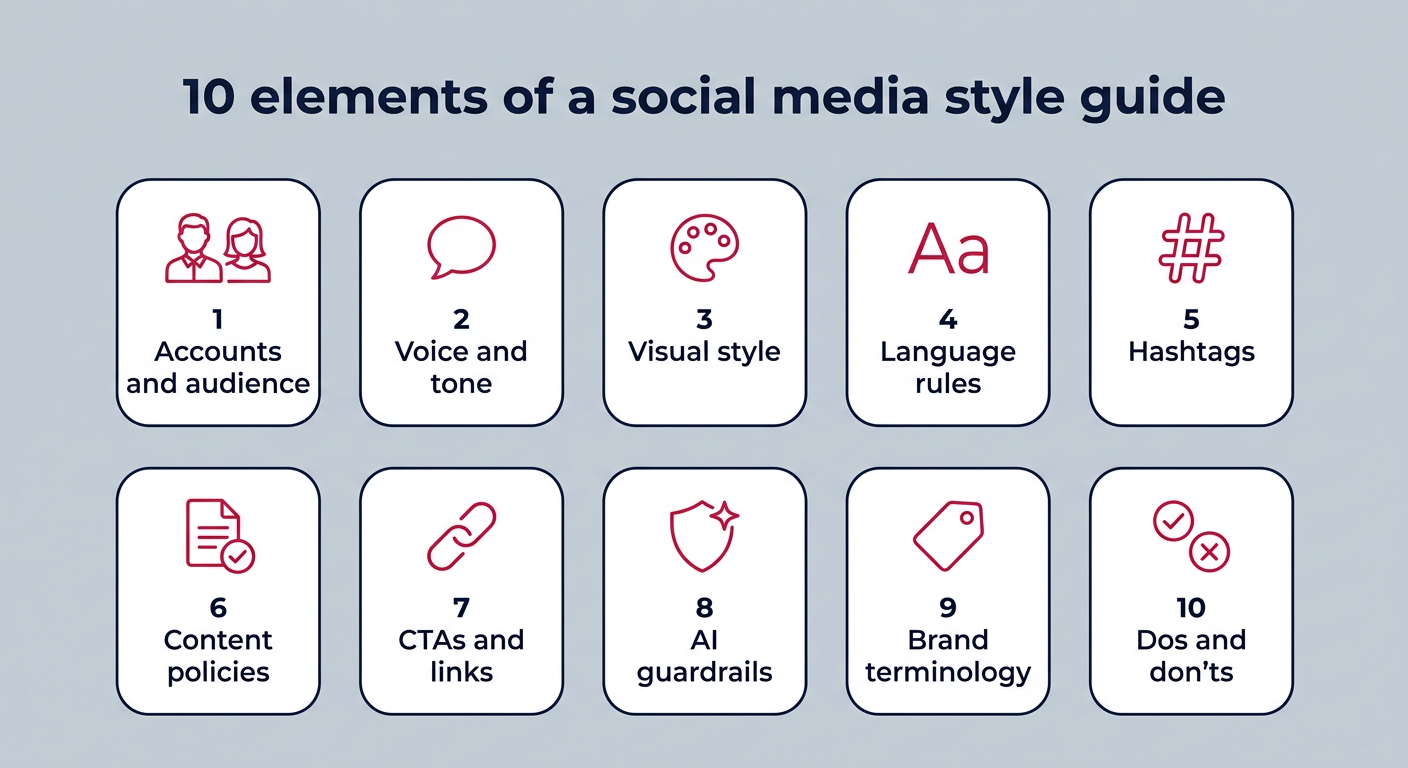
Creating a social media style guide involves documenting the rules and conventions that keep your brand consistent across every social media platform. The most effective style guides include 10 core elements:
- Your social accounts and target audience
- Brand voice and tone
- Visual style and assets
- Language and grammar rules
- Hashtag conventions
- Content policies for curation, user-generated content, and cross-posting
- CTAs and link conventions
- AI guardrails
- Brand-specific terminology and trademarks
- Dos and don’ts
1. Your social accounts and target audience
Start with the foundation: a complete list of every social account your brand uses, plus the audience personas those accounts are speaking to. Without this, every other decision in your style guide is happening in a vacuum.
For your account list, include:
- Every active account across every platform, including regional, product-specific, and customer service handles
- Dormant accounts your brand still owns (so they don’t get forgotten)
- The username conventions you use (e.g., @hootsuite vs. @hootsuite_official)
For your audience personas, include:
- Basic demographics (location, age, occupation)
- Interests, pain points, and what they need help with
- How they use social media and what kinds of content they engage with (e.g., blog posts, infographics, videos)
- Which social media channels they’re most active on
If you haven’t built audience personas yet, our audience persona template is a good starting point. The better you know your audience, the more useful every other section of your style guide becomes.
2. Brand voice and tone
Your brand voice is the personality your content takes on across every post, and your tone is how that voice shifts based on context. Document both so your team writes content that sounds like one brand, even when it’s coming from a dozen people.
In this section, define:
- Voice attributes: Pick a handful of adjectives that describe your brand personality (e.g., warm, witty, expert).
- Tone shifts: Your tone will naturally shift in different contexts (e.g., more upbeat in launches, more measured in complaint replies). Document what each shift should look like.
- Post length: Decide on a typical length for captions and videos on each platform. Audiences come to expect a certain length, and breaking the pattern feels off. Different platforms have different character limits, so you’ll need to break this down by platform.
- Emoji and GIF use: Define how often your brand should use them, in what contexts, and any that feel off-brand.
- Inclusive language guidelines: Inclusivity is a baseline expectation for any modern brand. Document the terms, phrases, and references your brand uses (and avoids) to make sure your content is both accessible and respectful.
- Post authorship: Decide whether posts come from “the brand” or specific team members. Customer service replies often use initials, while video content tends to feature named people on camera.
Adjectives only go so far. The fastest way to show your team what your voice sounds like is a short “this, not that” table they can skim before they write:
|
This (on-brand) |
Not that (off-brand) |
|---|---|
|
“Here’s how to fix that.” |
“We sincerely apologize for any inconvenience.” |
|
“We tested this. Here’s what worked.” |
“Studies show that leveraging synergies can drive outcomes.” |
|
“New feature: schedule a month of posts at once.” |
“We are thrilled to announce an exciting new innovation!!!” |
|
“Good question. Short answer: yes.” |
“Thank you for reaching out to us regarding your inquiry.” |
|
“This one’s for the people who hate meetings.” |
“Designed for the modern professional.” |
Fill the table with real examples from your own feed, including a few lines that got the tone wrong. Teams learn faster from a before and after than from a list of adjectives.

Source: @TangerineHelps
Pro tip: Not sure what brand voice to land on? Try experimenting with Hootsuite’s free AI caption generator. It allows you to choose different tones of voice, from cheerful to unhinged to VSCO girl. Try using it to create different versions of the same caption and see which feels more natural for your brand.
3. Visual style and assets
A social media style guide locks in the decisions that keep your brand recognizable. Without clear guidelines, your brand image starts to feel unpredictable.
In this section, include:
- Colors: List your primary and secondary brand colors (and their hex codes), along with notes on when to use each.
- Fonts: Specify the fonts your team uses in graphics, cover photos, Stories, and thumbnails. Most brands need one to three fonts max.
- Logos: Note when and where to use your logo, and include modified versions for square and circular formats (like profile pictures).
- Thumbnail style: Define the thumbnail style for your video content. Bonus points for including real examples your team can reference.
- Templates: Templates are the best way to keep your visual content high-quality and consistent. Build reusable templates for Instagram Stories, Pinterest pins, and everything in between. Make sure to link to them directly in your style guide.
- Image standards: Decide whether you use stock photos, original photography, or a mix, and document where you source them from.
Once your visual assets are documented, store them somewhere your whole team can access. The Hootsuite content library keeps your approved templates, images, and brand assets in one place, so anyone creating content can grab what they need with ease.
4. Language and grammar rules
Your style guide should lock in the small grammar and formatting decisions that would otherwise vary post by post.
Start by picking an existing style reference (like Associated Press Stylebook or the Chicago Manual of Style) so you don’t have to make every grammar and punctuation choice yourself. Then, document your team’s choices on:
- English variant: Choose between US, UK, Canadian, or Australian English based on your primary audience
- Serial commas: There’s no right answer on whether to use them. The Associated Press says no, Chicago says yes. Make your own choice and use it consistently.
- Headline capitalization: Do you capitalize every word, or only the first? Pick your preferred case style: title case, sentence case, or all lowercase.
- Dashes: Dashes come in two lengths: the en-dash (–) and the em-dash (—). Specify whether you’ll use one, both, or neither. Many brands now avoid em-dashes entirely because they’ve become a tell for AI-generated content.
- Exclamation points: Decide when to use them and how many at a time. It’s a good idea to keep them to a minimum on most platforms, unless you’re going for a specifically chipper brand voice.
- Dates and times: Pick a format (4 p.m. vs. 4pm vs. 16:00) and an order (month/day/year vs. day/month/year). Inconsistency can cause real problems, like a missed event or launch.
- Pronunciation: If your brand or product names have unclear pronunciations, include a quick pronunciation guide for video and audio content.
These feel like small choices, but they add up. A feed with inconsistent capitalization, dashes, and date formats reads as careless even if every post is on-strategy.
5. Hashtag conventions
Hashtags need their own section because they touch discoverability, campaigns, and brand identity all at once. It’s a good idea to note how your team uses them so the strategy stays consistent.
Make sure to cover:
- Branded hashtags: Do you use branded hashtags to encourage fans to tag you in their posts, or to collect user-generated content? List them in your style guide with guidelines about when to use them. Plus, provide guidelines for how to respond when people use your branded hashtags (e.g., will you like their posts? Retweet? Comment?).
- Campaign hashtags: Keep a running list of hashtags for one-off or ongoing campaigns, along with start and end dates. This gives you a permanent record and a head start when planning future campaigns.
- Quantity per post: Set a typical range for how many hashtags your team should use per post on each platform. Skip a specific number and test what works for your audience instead.
- Capitalization: Pick one case style and stick with it: lowercase (#hootsuitelife), camel case (#HootsuiteLife), or all caps (#HOOTSUITELIFE, best reserved for short hashtags). Camel case is generally most accessible because screen readers can parse the word breaks.
Pro tip: Your hashtag strategy isn’t set-it-and-forget-it. Revisit your conventions every quarter or so, because what worked last year on Instagram might not be moving the needle this year.
6. Content policies for curation, UGC, and cross-posting
Beyond what you create yourself, document how your brand handles outside content. These social media content guidelines cover three key areas:
Curation: Sharing content from other sources
Curated content can add value to your social feed without creating new content of your own. But, you’ll need to decide:
- Which sources you’ll share from, and which you won’t (e.g., direct competitors)
- Whether your team adds commentary or shares as-is (Psst: The LinkedIn algorithm, in particular, prefers it when you add your own perspective)
- How you credit original sources
User-generated content (UGC): Sharing content created by your audience
UGC is some of the best content a brand can share because it doubles as social proof. But it also comes with legal and ethical considerations your team needs to get right every time. Outline:
- How your team will request permission before reposting (and what to do if you don’t get a response)
- How you’ll credit the original creator
- Whether you’ll offer something of value in return, like a feature, repost, or small gift
- How your team will use social listening to find UGC mentioning your brand
Cross-posting: Repurposing your own content across platforms
Repurposing gives you extra mileage out of your social content. However, cross-posting the exact same thing everywhere is rarely the right move, since each platform has its own format, audience, and unwritten rules.
To do it right, document:
- Which content gets adapted for which platform (e.g., a blog post becomes an Instagram carousel, or a longer YouTube video gets divided into TikTok clips). Cross-network post reporting can help you spot which adaptations are actually working.
- How copy, format, and visuals change per platform
- Which posts shouldn’t be cross-posted at all (e.g., platform-specific trends)
7. CTAs and link conventions
CTAs are small, but they’re some of the most-read words in any post. Lock the rules down and your team will write better ones without thinking about it.
Pay close attention to your:
- CTA frequency: How much of your content directly promotes your brand vs. informs, educates, or entertains? We follow the commonly referenced 80/20 guideline (80% non-promotional, 20% promotional), but pick the ratio that matches your audience.
- CTA language: List the action verbs your brand uses (“Learn more,” “Shop now,” “Try free”) and any phrases you avoid. Your CTA language is part of your brand voice, so it should feel like a natural extension of it.
- CTA placement: Specify where CTAs live: in captions only, or also within video content? Different platforms call for different approaches.
- Linking rules: Decide whether your team uses UTM parameters or URL shorteners, and where to include links (e.g., caption only first comment, etc.).
For platforms where your bio link is the only option (Instagram, TikTok), clarify how you reference that in posts (“link in bio,” “link in our profile,” etc.) so your team uses one phrasing consistently.
8. AI guardrails
With AI tools embedded in nearly every social workflow, your style guide needs to define how your team uses them. To keep everyone on the same page, include your AI guardrails:
- Approved tools: List the AI tools your team is allowed to use, like ChatGPT, Hootsuite’s Wisdom, Claude, or Midjourney. Naming the approved stack keeps everyone working from the same playbook.
- What AI is and isn’t allowed to do: Outline the tasks AI is allowed to handle (e.g., drafting captions or brainstorming hooks) and the ones it isn’t (e.g., generating images of real people, fabricating quotes, or creating content for sensitive topics).
- The QA process: Define how your team reviews AI-generated content before it goes live.
- Disclosure rules: Decide whether and when your team discloses AI use. Some platforms now require it — TikTok alone has labeled over 1.3 billion AI-generated videos.
- Governance and audit trails: If you work in a regulated industry, document who approved each post, which tool produced the draft, and where that record lives. A governance screening tool can automate part of this — otherwise, regulators and legal teams will ask, and reconstructing it after the fact is painful.
9. Brand-specific terminology and trademarks
Every brand has language that’s specific to it (think: product names, internal nicknames, and industry-specific terms). Document them all in one place so your team uses them correctly every time.
Include:
- Trademarks: List every trademarked product or feature with correct capitalization (e.g., Hootsuite, not HootSuite). Don’t write trademarks in all-caps in your style guide, because that hides the actual formatting your team needs to copy.
- Trademark usage rules: Specify whether your product names can be used as verbs or plurals. In most cases, they can’t (you can’t “Hootsuite” a post, for example), so spell out the right way to reference them in copy.
- Brand and product callouts: Create a list of unique selling propositions and standard call-outs for your brand and all your products. Your team won’t copy-paste these into posts, but having them in one place keeps everyone aligned on how to describe what you offer.
- Acronyms: Keep a running list of acronyms your team uses internally, alongside their spelled-out versions. Clarify which acronyms are okay to use on social and which should be spelled out for general audiences.
- Brand-specific language: Write down the words your brand uses for the people in and around it. For example, at Hootsuite, we call our employees “owls,” Starbucks calls theirs “partners.” Most brands also have a preferred term for their audience, too (customers, clients, members, guests).
- Industry terms: Note the words your industry uses that outsiders often get wrong. For example, a cruise is a “ship,” not a “boat.” A restaurant has “guests,” not “customers.” These details matter, so document the right and wrong terms side by side.
10. Dos and don’ts
Close out your style guide with a quick list of the rules your team needs to remember. This section is the one people will actually look at most often, so keep it scannable.
Here’s what to cover:
- Jargon: List the jargon-y words and industry-speak your team should avoid, and offer plain-language alternatives where possible. Unless your audience is highly technical, default to clear, everyday language.
- Off-limits topics: Outline any topics that are a no-no for your brand, like politics or commentary on competitors. This is especially important for brands in regulated industries.
- Content types: Define what kinds of content are fair game (e.g., product shots, employee photos, memes, customer stories) and what’s not (e.g., anything that violates platform rules, breaches privacy, or doesn’t fit your brand). Be specific so your team doesn’t have to guess.
- Link to your full social media policy: A style guide covers how you create content. A social media policy covers how your employees can use social on behalf of (and outside of) the brand. Link to it so your team has both.
How do I adapt my style guide for different platforms?
You adapt your style guide by keeping one set of brand-level rules for voice and visuals, then layering platform-specific guidelines on top. The brand stays recognizable everywhere, while each post still fits the place it lives.
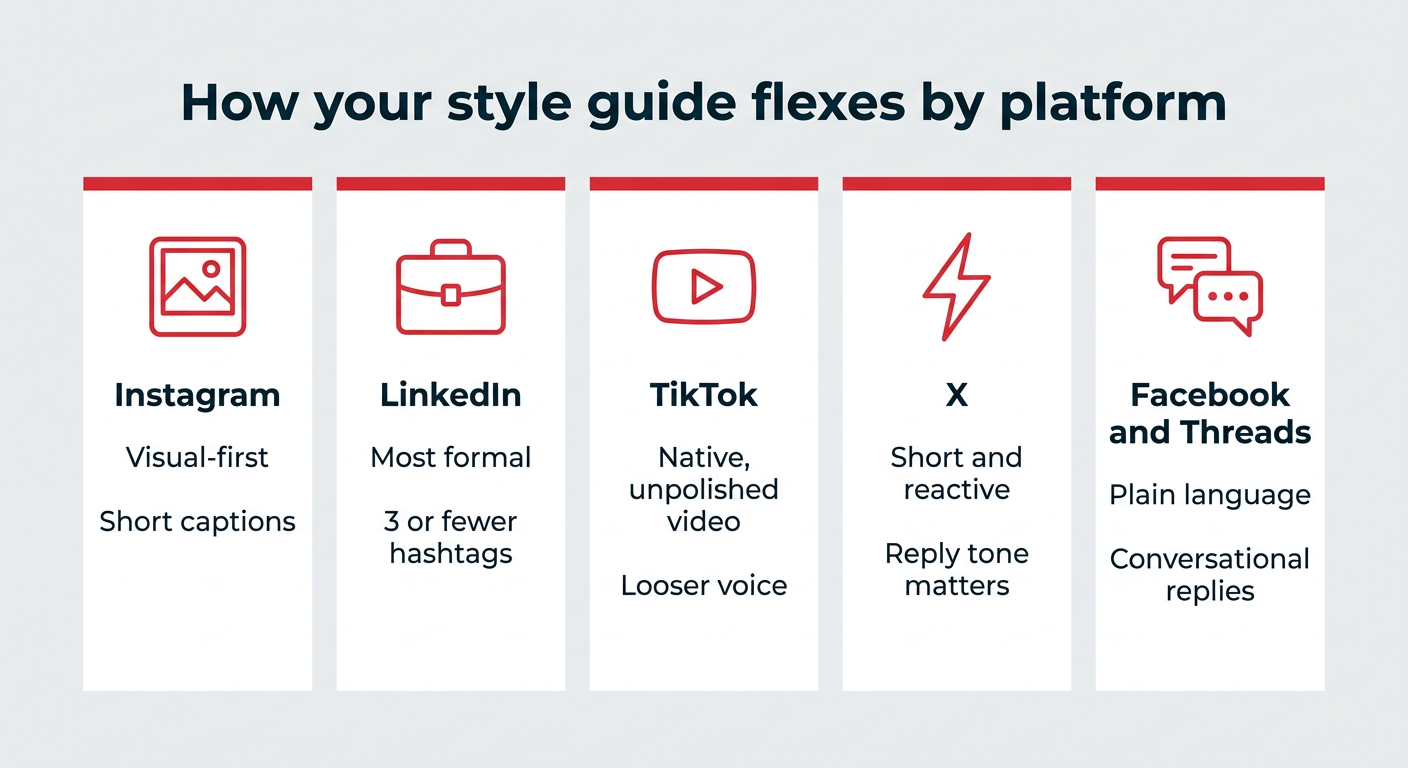
Here’s what typically changes by platform:
- Instagram: Visual-first, so your image and video standards carry the most weight here. Captions tend to run short with the detail front-loaded, hashtag volume is moderate, and Stories allow a looser, more casual tone than your grid.
- LinkedIn: The most formal of the bunch, but formal doesn’t mean stiff. Longer posts perform, first-person perspective from named employees works better than brand-voice announcements, and hashtags stay minimal (three or fewer is a common rule).
- TikTok: Native, unpolished video wins over studio-quality assets. Note which trends and sounds your brand will join, who can appear on camera, and how your voice loosens up here compared to other channels.
- X: Short, fast, and reactive. This is where reply tone matters most, since much of your presence is conversation rather than publishing. Document how punchy your brand is allowed to get and where the line sits.
- Facebook and Threads: Mixed formats and broader audiences, so default to plain language and fewer in-jokes. Threads rewards conversational posts and quick replies, while Facebook often skews toward community groups and longer-form updates.
What engagement and community guidelines should I include?
Your engagement guidelines should cover reply tone, response times, escalation paths, moderation rules, and crisis protocols. Publishing rules only govern half of what your team does on social, and the other half happens in comments and DMs where there’s no time to check a document.
Cover these five areas:
- Reply tone and voice: Replies usually sound more human and less polished than published posts. Document how far your team can flex, whether they sign off with initials, and which situations call for a warmer tone.
- Response time expectations: Set target response windows by platform and message type, and note your coverage hours. A question about a product and a complaint about a billing error don’t need the same clock.
- Escalation paths: Spell out what gets escalated, to whom, and how fast. Legal threats, safety issues, media requests, and anything touching regulated claims should never sit in a social inbox waiting for a decision.
- Comment moderation rules: Define what your team hides, deletes, reports, or leaves alone. Being explicit here protects your moderators from making judgment calls on hate speech, spam, and harassment in the moment.
- Crisis and PR rules: In a social media crisis, document what to pause (scheduled posts, ads, promotional content), what to escalate, and who to loop in when something goes wrong. The middle of a crisis is the worst time to figure this out.
1. Mailchimp
Mailchimp is an email marketing platform whose public style guide is often cited as one of the gold standards in the industry.

Their social media section is thorough, covering everything from the intent of their social strategy to account naming conventions, post length, and tagging protocols.
2. Events DC

Source: Events DC
Events DC is the organization behind major events, conventions, and sports at venues across Washington, D.C. Their style guide nests social media inside a broader brand style guide, which keeps logos, colors, imagery, and post guidelines together in one document.
3. Society of Women Engineers

Source: Society of Women Engineers
The Society of Women Engineers is a nonprofit professional organization supporting women in engineering and technology. Their style guide defines how the society uses every social platform, then focuses on the four they use most: Facebook, X (formerly Twitter), Instagram, and LinkedIn.
How do I maintain and update my style guide?
Building a social media style guide isn’t a one-time project. Treat it as a living document that grows with your brand, your platforms, and the ways your team works. The first version doesn’t need to be perfect, it just needs to exist. From there, update it as you learn what works.
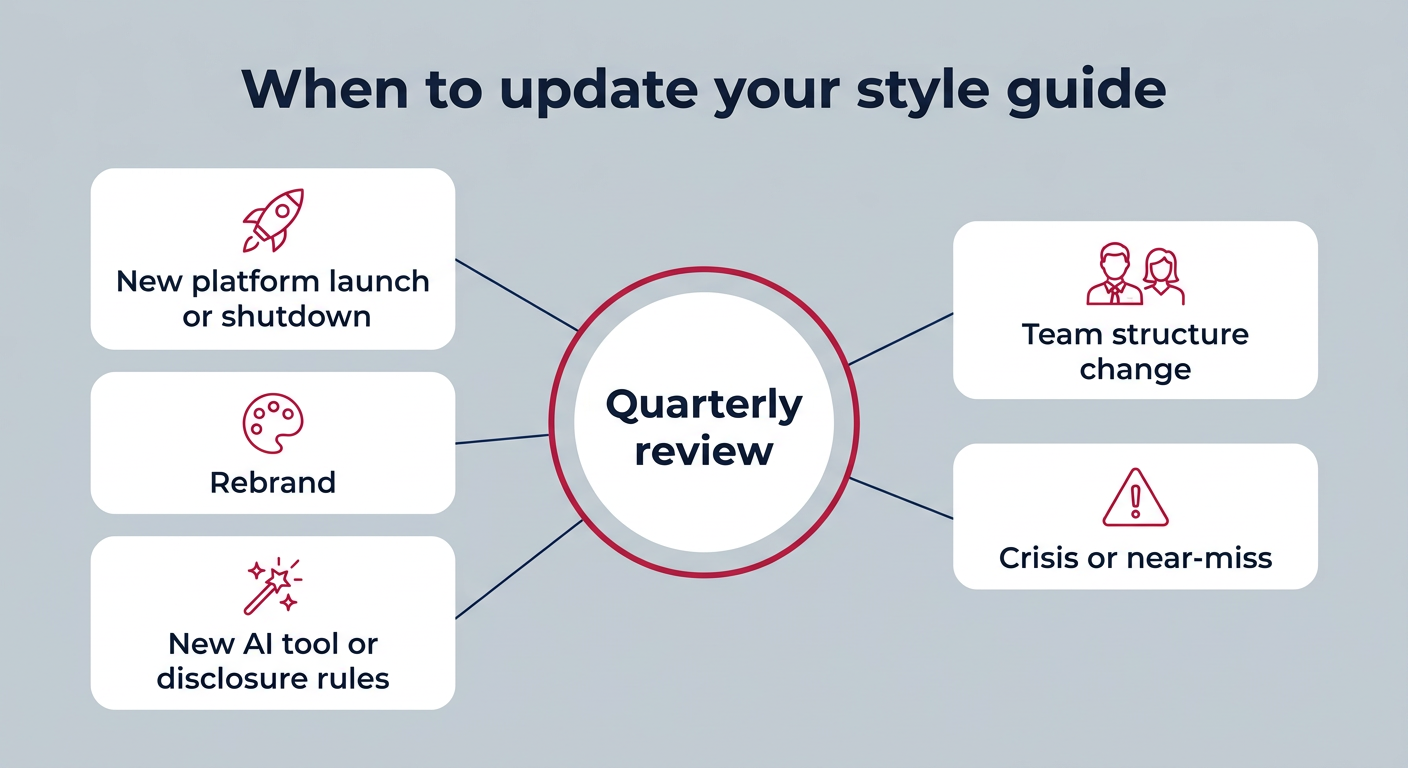
A quarterly review is enough for most teams. Block 30 minutes, skim the guide against your last three months of posts and current social trends, and fix anything your team has already stopped following.
Some changes shouldn’t wait for the next review. Update the guide off-cycle when:
- You launch on a new platform or shut one down
- Your brand rebrands, or visual identity and messaging shift
- Your team structure changes, like adding regional teams or bringing on an agency
- You adopt a new AI tool, or a platform changes its AI disclosure rules
- A crisis or near-miss teaches you something your guide didn’t cover
FAQ: Social media style guide
What is a social media style guide and why is it important for brands?
A social media style guide is a document that defines how your brand looks, sounds, and behaves across every social platform. It’s important because without one, every team member ends up making their own micro-decisions, and your feed starts to feel inconsistent.
What should be included in a social media style guide?
A social media style guide should include 10 elements: your accounts and target audience, brand voice and tone, visual style and assets, language and grammar rules, hashtag conventions, content policies, CTAs and link conventions, AI guardrails, brand-specific terminology, and a list of dos and don’ts. Together, these give your team one source of truth for staying on-brand on every platform.
How do enterprises maintain brand consistency across social media teams?
Enterprises maintain brand consistency by recording voice, visuals, and content rules in a shared style guide, then centralizing publishing, approvals, and reporting across every team and region in Hootsuite.
Social media style guide vs. brand guidelines: what’s the difference?
Brand guidelines cover how your brand shows up across every channel, including your website, ads, packaging, and print. A social media style guide focuses specifically on social, covering the platforms and formats that don’t apply anywhere else.
How often should I update my social media style guide?
Review your social media style guide at least once a quarter, and update it any time your brand launches on a new platform, undergoes a rebrand, or changes team structure. Adopting a new AI tool or learning something from a crisis are also good reasons to update off-cycle.
How do I get freelancers and agencies to follow my style guide?
Share your style guide during onboarding and include it in every creative brief so external partners have the same reference your internal team uses. It also helps to link the guide directly inside your project management tool and flag the two or three rules partners most often get wrong.
Should my social media style guide include AI usage rules?
Yes, your style guide should include AI guardrails that specify which tools are approved, what tasks AI can handle, and how your team reviews AI-generated content before publishing. If you work in a regulated industry, also document who approved each post and where that record is stored.
What is the difference between brand voice and brand tone?
Brand voice is your consistent personality across all content, while brand tone is how that personality shifts depending on context, such as a product launch versus a customer complaint. Your voice stays the same everywhere; your tone adjusts to the moment.
How do I create platform-specific social media guidelines?
Start with a single set of brand-level rules for voice and visuals, then layer platform-specific adjustments on top for things like caption length, hashtag volume, and content format. Keep each platform section short and list only what differs from the brand-level rules.
What is the 5-3-1 rule for social media?
The 5-3-1 rule is a commonly referenced content ratio framework where, out of every nine posts, five share content from others, three are original brand content, and one is a direct promotion or sales post. It’s a starting point rather than a law, so test the mix against your own engagement data.
Can I use a social media style guide template or should I build one from scratch?
A template is a great starting point because it gives you a proven structure to fill in, but you should always customize it to match your brand’s specific voice, platforms, and workflows. Most teams move faster by editing a template than by deciding what sections to include from a blank page.
Save time managing your social media marketing strategy with Hootsuite. Publish and schedule posts, find relevant conversions, measure results, and more â all from one dashboard. Try it free today.